

One change at a time may sound too simple, especially when you feel that many areas of your life need attention. You may want to improve your health, organize your home, change your work situation, rebuild your confidence, set boundaries, manage money better, and create more peace all at once. The desire is understandable. When you finally decide that something has to change, you may want everything to change quickly. But trying to change everything at once often creates more pressure than progress.
That is why Rule 3 in my guide 11 Rules for Changing Your Life is to focus on one change at a time. When you choose one clear change, you give your mind, body, and daily routine a better chance to adapt. If you want the full framework behind this approach, you can also read How to Change Your Life with the Analyze, Visualize, Modify Method.
Use AVM to Choose One Change
Choosing one change does not mean ignoring the rest of your life. It means choosing where to begin. The AVM Method can help you decide which change matters most right now.
Analyze: Look at your current life honestly. Which area creates the most stress, confusion, avoidance, or emotional weight? Is it your health, relationship, work, income, home, habits, or daily routine?
Visualize: Ask what would feel lighter, calmer, or more supportive if one thing improved. You are not looking for a perfect life. You are looking for the first change that would create relief or momentum.
Modify: Choose one small, specific action connected to that change. Make it repeatable. Make it realistic. Make it clear enough that you know exactly what to do today.
One change at a time is not a limitation. It is a way to protect your focus and build trust with yourself.
Why One Change at a Time Works Best
Making a life change can feel overwhelming, especially if you try to tackle multiple changes at once. Instead, focusing on one change at a time allows you to make steady progress without feeling frustrated or giving up. When you concentrate on a single habit, you give yourself the best chance to succeed. You eliminate distractions, create momentum, and increase the likelihood that the change will stick.
Should You Change One Habit at a Time?
You might be wondering, Do I really need to focus on just one change at a time? What if I want to improve multiple areas of my life? The short answer is: yes, one at a time is best.
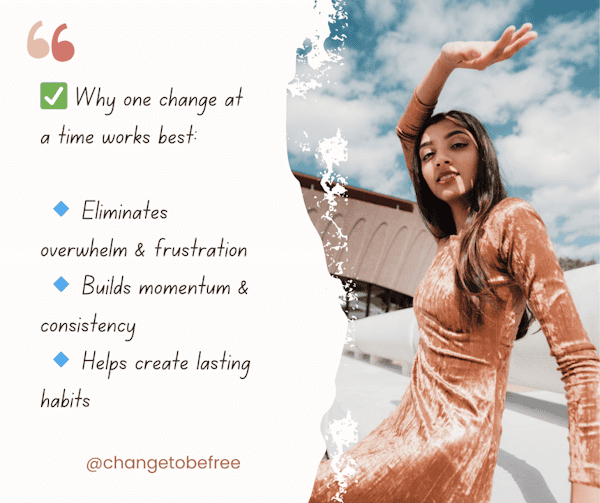
If you try to change too many things at once, you risk becoming overwhelmed and quitting. When you spread your focus too thin, your brain struggles to form new habits. On the other hand, when you focus on just one change, you allow it to become automatic before moving on to the next.
That doesn’t mean you have to wait until you reach your ultimate goal before making another change. Once your new habit feels natural—like stretching for five minutes every morning without thinking about it—you can introduce the next small step.
Read here to learn why small steps are important and how they lead to big changes.
How Long Does It Take to Change a Habit?
There’s a common myth that it takes 21 days to form a habit, but research suggests otherwise. Research on habit formation shows that habits become more automatic through repeated behavior in a stable context. Health psychology researcher Phillippa Lally from University College London conducted a study to determine how long habit formation really takes. The study followed 96 participants over 12 weeks, tracking new habits ranging from drinking a glass of water with lunch to running before dinner.
What Happens When You Focus on One Change
On average, it took 66 days for a habit to become automatic. However, the time varied between 18 and 254 days, depending on the individual and the complexity of the habit. This means some habits might take only a few weeks, while others require months of repetition.
What If You Miss a Day?
Good news! The study found that missing a day did not significantly impact habit formation. This proves that consistency is more important than perfection. You don’t need to be perfect—you just need to keep going.
When to Start the Next Change
You’ll know it’s time to introduce another change when your current habit feels automatic. If you no longer have to remind yourself to do it, or if you do it effortlessly as part of your routine, you’re ready. A good rule of thumb is to ask yourself: Do I still need to focus on this habit, or does it feel natural? If it’s becoming second nature, start working on your next habit—but don’t forget to maintain the first one.
Final Thoughts about One Change at a Time
One change at a time is not slow in a negative way. It is steady. When you focus on one change, you reduce overwhelm, build consistency, and give yourself a real chance to follow through. You stop scattering your energy across ten different promises and start building trust with one repeated action. If you miss a day, you return. If the step is too big, you make it smaller. If the change becomes stable, you choose the next one. This is how real transformation becomes more manageable. Not everything at once. One change. One honest action. One repeated step.
Read the full guide here: 11 Rules for Changing Your Life.