

Learning how to set financial goals is about more than choosing numbers. It is about creating a life that feels secure, meaningful, and aligned with what matters most to you. Visualizing your financial future means creating a clear picture of the life you want your money to support before deciding how to spend, save, or invest it. In the AVM Method, Visualize is the second step. After analyzing your current financial reality, you decide where you want your money to take you and what kind of life you want it to support.
A clear financial vision gives purpose to your goals. It helps you move beyond vague intentions such as saving more or spending less and begin making financial decisions that reflect your values, priorities, and stage of life. In this guide, you will learn how to define financial freedom for yourself, visualize your future lifestyle, set realistic financial goals, and connect your everyday money decisions with the life you truly want to create.
Why Visualization Helps You Set Financial Goals
Visualization is the bridge between understanding your current financial situation and creating the future you want. Many people know they should save more, spend less, or pay off debt. The problem is rarely a lack of financial advice. The problem is often a lack of direction. Without a clear vision, even good financial advice is difficult to apply consistently. Without a clear destination, it’s easy to make financial decisions based only on today’s circumstances. You react to unexpected expenses, emotional spending, or short-term wants instead of making choices that support the future you want to build.
This shift changes the way you think about money. Instead of focusing only on how much money you have today, you begin thinking about the life you want your money to support. This is why Visualize comes after Analyze in the AVM Method. Before deciding where you want to go, you first need to understand where you are. That’s exactly what you do in Analyze Your Spending Habits: Understand Where Your Money Really Goes. Once you understand your income, expenses, obligations, and spending patterns, you can create a financial vision that is both meaningful and realistic.
Your money mindset also plays an important role. If you see money only as a source of stress or limitation, it’s difficult to plan confidently for the future. But when you begin to see money as a tool that supports your goals, relationships, health, home, and personal freedom, financial planning becomes clearer and your decisions become more intentional. A clear financial vision won’t prevent unexpected expenses, career changes, divorce, health challenges, or economic uncertainty. What it does provide is direction.
It reminds you why you’re making financial decisions today and helps you stay focused when progress feels slower than expected. That’s why visualization isn’t about wishful thinking. It’s about creating a direction that guides every financial decision you make. To see how this step fits into the complete financial system, read The AVM Spending Plan: Financial Planning Made Simple before moving on to the next step of the AVM Method.

Define Financial Freedom Before You Set Financial Goals
Financial freedom means something different to everyone. For one person, it may mean becoming debt-free. For another, it may mean working fewer hours, traveling more, or having enough savings to handle unexpected expenses without stress. For many women over 40, financial freedom means having choices. It means feeling secure enough to make decisions based on what truly matters rather than simply on what they can afford today.
There is no single definition of financial success. The most meaningful financial goals are the ones that support your life, your values, and the future you want to create—not someone else’s definition of success.
Take a moment to reflect:
“What would financial peace look like for me five years from now?”
Write down your answer.
Perhaps it’s living without credit card debt, building an emergency fund, investing for retirement, starting your own business, traveling more, supporting your family, or simply knowing that an unexpected expense won’t cause panic. Whatever your answer is, make it personal. Your financial goals don’t need to impress anyone else. They only need to support the life you truly want to live. When your goals reflect your own priorities instead of outside expectations, they become much easier to pursue—and far more rewarding to achieve. Once you’ve defined what financial freedom means to you, the next step is to imagine what that future actually looks like in your everyday life.
Visualize Before You Set Financial Goals
Now that you’ve defined what financial freedom means to you, it’s time to bring that vision to life. Instead of thinking only about money, imagine the life you want your money to support. Money goals become meaningful when they help you create the life you truly want—not just a healthier bank account. Before choosing exact numbers, picture your ideal day.
- Where would you like to live?
- How would you like to spend your time?
- Who is with you?
- What kind of work do you do?
- How do you feel when you check your bank account?
Ask yourself:
- How do I want to spend my time?
- What kind of work-life balance do I want?
- What would make my home feel peaceful and secure?
- Which relationships, hobbies, or experiences matter most to me?
- What financial choices would allow me to live that life?
Your vision might include:
- working fewer hours,
- creating a comfortable home,
- traveling once or twice a year,
- supporting your children’s or grandchildren’s education,
- starting a creative business,
- investing for retirement,
- or simply living with less financial stress.
These images give meaning to your financial goals. Instead of saving because you feel you should, you begin saving because you’re building something that truly matters to you. You’re no longer chasing money. You’re creating a life that feels rich in the ways that matter most. Once the picture becomes clearer, you’re ready to turn it into practical goals that support the life you’ve imagined.

How to Set Financial Goals That Feel Authentic
Once you have a clear vision of the life you want to create, it’s time to turn that vision into practical financial goals. Effective financial goals are realistic enough to keep you engaged while still moving you closer to the future you want. They should reflect your current income, responsibilities, energy, and stage of life—not an ideal version of yourself or someone else’s expectations.
A simple way to create meaningful goals is to use the SMART framework:
- Specific – Clearly define what you want to achieve.
- Measurable – Decide how you’ll measure your progress.
- Achievable – Set goals that challenge you without becoming overwhelming.
- Relevant – Make sure each goal supports your financial vision.
- Time-bound – Give yourself a realistic timeframe.
For example, instead of saying,
“I want to save more money.”
try:
“I want to build a €1,000 emergency fund within the next 12 months.”
A clear goal is easier to follow, measure, and adjust as your circumstances change. It also helps to divide your financial goals into different timeframes.
Short-Term Financial Goals (Within 12 Months)
Short-term goals help you build financial stability and confidence because you can usually see progress relatively quickly.
Examples include:
- building your first emergency fund,
- paying off a credit card,
- creating your first spending plan,
- saving for annual or irregular expenses,
- reducing unnecessary monthly spending,
- or setting aside money for an important purchase.
Medium-Term Financial Goals (1–5 Years)
Medium-term goals often require greater consistency and planning.
Examples include:
- becoming debt-free,
- changing careers,
- starting a business,
- buying a reliable car,
- building larger savings,
- or preparing for a significant life event.

Long-Term Financial Goals (More Than 5 Years)
Long-term goals focus on creating lasting financial security and greater freedom.
They may include:
- investing for retirement,
- buying a home,
- paying off a mortgage,
- achieving financial independence,
- or creating the freedom to work because you choose to—not because you have to.
Remember, you don’t have to pursue every goal at the same time. Choose the goals that matter most in your current season of life. As your circumstances change, you can add new goals, adjust existing ones, or redefine your priorities. The purpose isn’t to create a perfect financial plan. It’s to create a realistic direction that helps you make better financial decisions every day.
Set Financial Goals for Your Future Lifestyle
One of the most powerful parts of financial visualization is imagining the lifestyle you want your money to support. Financial goals are not only about reaching retirement or accumulating wealth. They’re about creating a life that gives you greater security, freedom, and choice. Think beyond your bank balance. Imagine your future lifestyle.
Ask yourself:
- Where would I like to live?
- What kind of home would make me feel comfortable and secure?
- How much free time would I like to have?
- What hobbies, travel, or experiences would I like to enjoy?
- How important are family, health, or giving back to others?
- What level of monthly income would allow me to live that life?
You don’t need to know every answer today. The purpose of visualization is to create direction, not a perfect prediction.
Once your vision becomes clearer, begin asking practical financial questions:
- How much might this lifestyle cost?
- How much have I already saved or invested?
- What sources of income might I have in the future?
- How much time do I have to prepare?
- What small steps can I start taking today?
If retirement is one of your goals, online retirement calculators can help you estimate how much you may need to save. Remember that these tools are based on assumptions about inflation, investment returns, taxes, and future expenses, so use them as planning guides rather than exact predictions.
Everyone’s financial journey is different. Someone who starts investing at 25 will have a different plan than someone beginning at 45 after rebuilding their finances following divorce, burnout, or another major life transition. The important thing isn’t comparing your timeline with someone else’s. It’s creating a plan that works for your life today while moving you steadily toward the future you want. Once you have a clear picture of your future lifestyle, the next step is learning how to make everyday financial decisions that support it.
Visual Tools That Help You Set Financial Goals
A financial vision becomes easier to follow when you keep it visible. You don’t need complicated tools. The best visual tool isn’t the most sophisticated one; it’s the one you’ll actually use consistently.
You might choose:
- a vision board with images representing financial security, travel, retirement, or your ideal home,
- a digital goal tracker,
- an Excel spreadsheet that tracks your progress,
- a savings thermometer,
- a simple progress jar,
- or a financial journal where you record milestones, reflections, and achievements.
The purpose of these tools isn’t to pressure you. They’re designed to keep your long-term vision visible when everyday expenses, stress, and distractions compete for your attention. For example, saving €3,000 may feel overwhelming when you focus only on the final amount. But seeing that you’ve already saved €900 reminds you that every small contribution moves you closer to your goal. Visual tools also help you recognize when your priorities have changed.
Perhaps a goal that once felt exciting no longer reflects the life you want. Maybe another goal has become more important, or your circumstances have changed. That’s not failure. It’s part of the process. The AVM Method encourages regular reflection because your financial vision should change as your life and priorities change. Use the AVM Spending Plan Worksheet to record your financial goals and connect them with your monthly money decisions. It helps you balance Essential Spending, Savings, Investments, and Lifestyle Spending, making it easier to see whether your daily choices support your long-term vision.
If you’re looking for a simple way to organize your income, read The 50/30/20 Rule Explained. It’s a useful starting point, but remember that every spending plan should be adapted to your income, priorities, and stage of life. Visualization works best when it creates clarity—not perfection.
Whenever you review your goals, ask yourself one simple question:
“Am I still building the life I truly want?”
Align Your Goals with Your Values
Financial goals are much easier to achieve when they reflect what truly matters to you. Many people set financial goals because they feel they should. They save for things they don’t really want, compare themselves with others, or follow someone else’s definition of success. Over time, those goals lose their meaning—and so does the motivation to pursue them.
Instead, ask yourself one simple question:
“What do I want my money to make possible?”
Perhaps your answer is security. Perhaps it’s freedom. Maybe it’s spending more time with your family, improving your health, traveling, creating a peaceful home, or pursuing hobbies that bring you joy. There is no right or wrong answer. Your values become the foundation for every financial decision you make.
For example:
- If you value security, you may focus on building an emergency fund.
- If you value freedom, you may prioritize reducing debt and investing for the future.
- If you value family, you may save for meaningful experiences, education, or creating a comfortable home.
- If you value personal growth, you may invest in books, courses, coaching, or learning new skills.
When your spending reflects your values, financial decisions become much easier. Instead of asking only,
“Can I afford this?”
begin asking,
“Does this support the life I’m trying to build?”
That small shift changes the way you think about money. You no longer rely only on willpower to resist unnecessary spending. Your choices become guided by purpose, making it easier to stay consistent even when motivation fades. Financial goals stop feeling like restrictions and begin feeling like investments in the future you truly want to create.
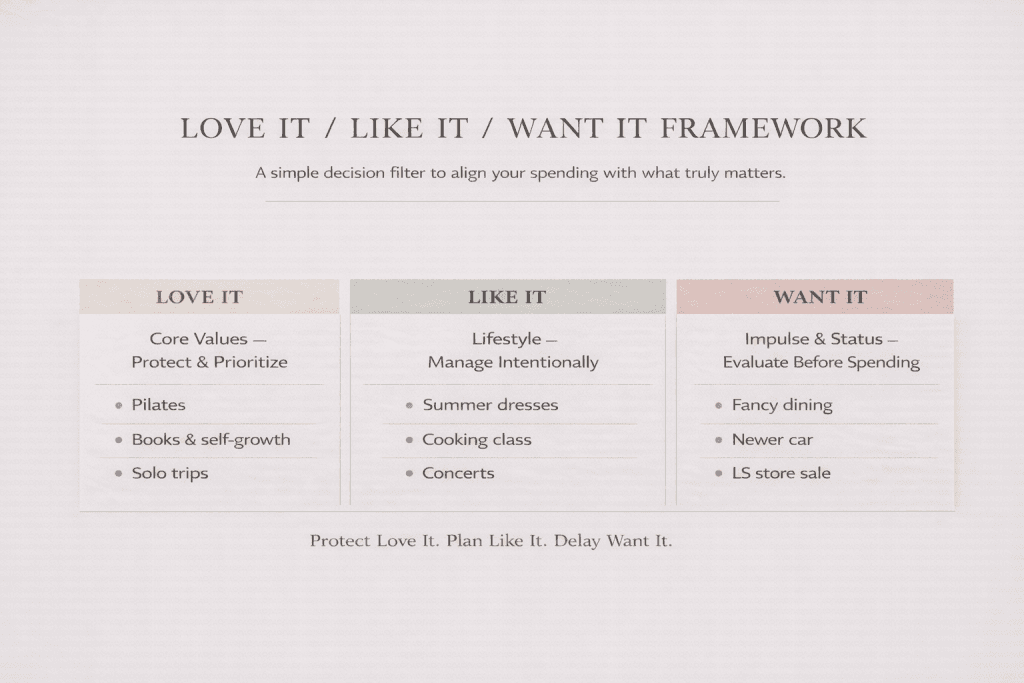
Love It, Like It, Want It: A Simple Way to Prioritize Your Spending
Once you have a clear vision of your financial future, it’s easier to decide where your money should go. One simple exercise that can help is Love It, Like It, Want It. Although this idea has been explored by various financial educators and authors, it’s an effective way to reflect on whether your spending truly supports the life you want to create.
Instead of asking whether you can afford a purchase, ask yourself:
“ Does this add lasting value to my life?”
Love It
These are the experiences, activities, and purchases that genuinely reflect your values and bring lasting satisfaction. For you, this might include improving your health, creating a peaceful home, spending time with loved ones, traveling, learning new skills, or investing in meaningful hobbies. Money spent here often feels worthwhile because it supports the life you truly want to build.
Like It
These are things you enjoy but could comfortably live without. Perhaps it’s eating out more often, another streaming subscription, takeaway coffee, or buying something simply because it’s on sale. There’s nothing wrong with these purchases, as long as they don’t gradually replace the things that matter most.
Want It
These are purchases driven mainly by impulse, trends, advertising, or comparison with others. They often bring short-term excitement but little lasting satisfaction because they aren’t connected to your deeper values or long-term vision. The purpose of this exercise isn’t to judge yourself or make you feel guilty. It’s simply to help you become more aware of where your money goes and whether it reflects the future you’re trying to build.
The more your spending supports your Love It list—and the less you direct toward items on your Want It list—the more closely your financial choices align with your long-term goals. If you’d like to explore this exercise in greater depth, read Love It, Like It, Want It: How to Spend More on What Truly Matters, where you’ll learn how to identify your true priorities and make more intentional spending decisions.
Adjust Your Financial Goals Along the Way
Your financial vision isn’t something you create once and follow forever. Life changes, and so do your income, responsibilities, and priorities. Major life events—such as changing careers, divorce, becoming a parent, children leaving home, health challenges, or preparing for retirement—can all reshape what financial security looks like. That doesn’t mean your original goals were wrong. It simply means your life has evolved.
Review your financial goals regularly, whether that’s every few months or at least once a year. Ask yourself:
- Do these goals still reflect the life I want to build?
- Have my priorities changed?
- Am I making progress toward what matters most?
- Do I need to adjust my timeline or expectations?
Changing a goal isn’t the same as giving up. Sometimes your destination stays the same, but the path changes. Other times, you discover that a goal you once thought was important no longer reflects the person you’ve become. One difficult financial season doesn’t define your entire journey. Unexpected expenses, job loss, divorce, illness, or other setbacks may slow your progress, but they don’t prevent you from creating a more secure future. Every small step you take still moves you forward.
The AVM Method encourages regular reflection because lasting financial transformation isn’t about following a perfect plan. It’s about making thoughtful adjustments as your life evolves while staying connected to the future you want to create. Once your vision feels clear, the next step is turning it into everyday action.
Continue with Modify Your Financial Habits: Small Changes That Make a Big Difference to learn how small, consistent habits can help you build the financial future you’ve imagined.
Key Takeaways
- Financial goals become more meaningful when they support the life you want to create, not just the amount of money you want to save.
- In the AVM Method, Visualize comes after Analyze, helping you choose a clear financial direction before changing your financial habits.
- Financial freedom looks different for everyone, so your goals should reflect your own values, priorities, and stage of life.
- Dividing your goals into short-, medium-, and long-term milestones makes them more realistic and easier to achieve.
- Visual tools and exercises such as Love It, Like It, Want It help keep your financial vision connected to your everyday spending decisions.
- Your financial goals should evolve as your life changes. Reviewing them regularly keeps your spending plan aligned with what matters most.
- Lasting financial transformation happens when a clear vision is followed by consistent action in the Modify phase of the AVM Method.
Conclusion: Build a Financial Future That Reflects Your Values
Financial goals are not just about reaching a number. They’re about creating a life that feels secure, meaningful, and aligned with what matters most to you. In the AVM Method, lasting financial change begins by understanding where you are (Analyze), deciding where you want to go (Visualize), and then taking small, consistent steps to get there (Modify). Your vision doesn’t need to be perfect. It only needs to be clear enough to guide your everyday financial decisions and flexible enough to change as your life changes.
As your life changes, your financial goals may change too—and that’s completely normal. What matters is continuing to move toward a future that reflects your values rather than someone else’s expectations. Take a few minutes today to imagine your ideal financial future. Then write down one meaningful goal that brings that future a little closer.
When you’re ready, download the free AVM Spending Plan Worksheet and start turning your vision into a practical spending plan that supports the life you truly want to create.
FAQ: Visualize Your Financial Future
Visualizing your financial future means creating a clear picture of the life you want your money to support. Instead of focusing only on numbers, you define what financial security, freedom, and success look like for you personally.
A financial vision gives your spending plan purpose. When you know where you want to go, it becomes much easier to decide how to spend, save, and invest your money intentionally.
Start by defining what financial freedom means to you. Then divide your vision into short-, medium-, and long-term goals that fit your current income, responsibilities, and stage of life.
That’s completely normal. Your priorities, income, and circumstances will change throughout life. Review your financial goals regularly and adjust them whenever they no longer reflect the future you want to create.
Once you have a clear financial vision, the next step is building financial habits that support it. Continue with Modify Your Financial Habits: Small Changes That Make a Big Difference to learn how small, consistent actions can help you achieve your long-term goals.
Ready to Turn Your Vision into Action?
A clear financial vision is the foundation of every successful spending plan. Once you know what you want your money to make possible, it becomes much easier to decide how to spend, save, and invest with confidence.
Download the free AVM Spending Plan Worksheet to organize your financial goals, clarify your priorities, and build a spending plan that reflects the life you truly want to create.

Download free AVM spending plan.