
Learning how to change financial habits takes more than motivation. It rarely happens because of one perfect budget, one month of strict discipline, or one promise to stop spending. It happens through the choices you repeat consistently. Financial freedom is not built by one perfect month. It is built by hundreds of ordinary decisions that quietly shape your future. You may already understand where your money goes and have a clearer picture of the financial future you want to create. But awareness alone does not change your finances. Knowing what needs to change and building that change into your everyday life are two different things.
This is where the Modify stage of the AVM Method becomes essential. Modify is about turning financial awareness and direction into practical routines, supportive systems, and everyday behaviors. Instead of relying only on willpower, you gradually create a life where healthier financial choices become the easier choices. Lasting financial change does not usually come from forcing yourself to try harder. It develops through realistic improvements that fit your responsibilities, income, priorities, and stage of life—even when life becomes busy or unpredictable.
The purpose of changing your financial habits is not simply to manage money better. It is to create more freedom, stability, confidence, and choice in everyday life. The AVM Method works because it follows a logical order. First, you Analyze your current financial reality. You look at your income, expenses, obligations, spending patterns, and the emotions influencing your financial decisions.
If you have not completed this first step yet, start with Analyze Your Spending Habits: Understand Where Your Money Really Goes.
Next, you Visualize the future you want your money to support. This gives every financial decision a meaningful direction instead of reducing money management to restriction and sacrifice. You can explore this step in Visualize Your Financial Future.
Finally, you Modify the habits, routines, systems, and surroundings that shape your everyday behavior. Without Analyze, you may try to change the wrong habit. Without Visualize, your spending plan may feel restrictive and disconnected from what truly matters to you. Without Modify, even the clearest insights and goals remain ideas instead of becoming part of the way you live.
Together, these three stages form the foundation of The AVM Spending Plan—a flexible approach that combines financial planning with self-awareness, purposeful decision-making, and lasting behavior change.
Key Takeaways
- To change financial habits for the long term, focus on repeated actions rather than temporary motivation.
- Small, realistic actions are usually easier to maintain than extreme financial restrictions.
- Systems and routines make supportive financial decisions easier to repeat.
- Your surroundings can either strengthen healthier habits or repeatedly trigger old ones.
- A weekly money check-in helps you review what happened, adjust your spending plan, and continue moving forward.
- Setbacks provide valuable information about what needs attention; they are not proof that you have failed.
- The Modify stage turns the awareness gained through Analyze and the direction created through Visualize into everyday action.
- Your spending plan should remain flexible enough to grow and change as your life changes.
What Does It Mean to Modify Your Financial Habits?
To change financial habits means making intentional changes to the way you spend, save, prepare for future expenses, and respond to money in everyday life. It does not mean controlling every dollar, removing every enjoyable expense, or following a rigid plan that only works during calm and predictable months. Instead, it means replacing financial behaviors that no longer support you with routines and systems that move you closer to greater stability, confidence, and freedom.
For example, modifying your financial habits might mean:
- setting up an automatic savings transfer,
- checking your finances once a week instead of avoiding them,
- planning for irregular expenses,
- pausing before an unplanned purchase,
- preparing a shopping list before going to the store,
- or adjusting your spending plan when your circumstances change.
Each change may seem small on its own. Together, repeated consistently, they can completely change the direction of your financial life. This becomes especially important after 40, when your financial life may be influenced by divorce, career changes, children becoming independent, aging parents, health concerns, rebuilding savings, or preparing for retirement. Your financial system should support the life you are living now—not the life you had ten or twenty years ago.

Why Changing Financial Habits Feels So Hard
Many people struggle to change financial habits because familiar patterns often return during stressful or demanding periods. You may begin a new month determined to spend less, save more, and finally follow your spending plan. For a while, everything may go well. Then work becomes stressful, an unexpected bill arrives, or family responsibilities take over. Before you fully notice what is happening, familiar patterns return. This does not necessarily mean that you lack discipline.
Many money habits have been repeated for years. They are often connected to familiar situations, emotions, and routines. You may shop online after a difficult day, order food when you feel exhausted, postpone opening bills when you feel anxious, or avoid checking your account because you are afraid of what you might find.
Familiar behaviors often require less conscious effort, especially when you are tired, stressed, or emotionally overwhelmed. This is why simply deciding to behave differently is rarely enough. You also need to understand what triggers the behavior and create a realistic alternative. Research on habit formation suggests that lasting behavior change is more successful when it focuses on consistent repetition, environmental cues, and supportive routines rather than relying on motivation alone.
A spending habit may also serve an emotional purpose. Buying something can create a brief sense of relief, reward, comfort, or control. Avoiding your bank account can temporarily reduce anxiety. Helping adult children financially may ease guilt, even when it weakens your own financial stability. These responses are understandable, but they can become expensive when they continue automatically. This is one reason the AVM Method begins with a detailed Analyze stage. Before trying to change your behavior, you first explore your income, expenses, obligations, emotional reactions, and recurring spending patterns.
If you have not completed this step yet, start with Analyze Your Spending Habits: Understand Where Your Money Really Goes, where you will learn how to identify the habits and patterns shaping your financial decisions. Once you understand what is happening, you can stop judging yourself and begin solving the real problem.
Instead of asking:
“Why am I so bad with money?”
Ask yourself:
“What situation, emotion, belief, or routine keeps leading me back to this behavior?”
That question gives you something practical to work with.
A habit that once helped you cope with stress, loneliness, uncertainty, or exhaustion may no longer support the life you are trying to build. Recognizing this does not remove responsibility for your choices. Instead, it allows you to respond with greater awareness, honesty, and self-compassion. Only then can you choose a new response that addresses the real need instead of repeating the same automatic behavior.
For example:
- If exhaustion leads to expensive takeaway meals, the solution may be simpler meal planning rather than harsher self-criticism.
- If anxiety leads you to avoid your finances, a short scheduled money check-in may feel safer than waiting until a problem becomes urgent.
- If stress triggers online shopping, you may need a different way to pause, regulate your emotions, and create distance from the purchase.
- If helping others repeatedly weakens your own finances, the next step may involve setting healthier financial boundaries.
It becomes easier to change financial habits when you stop treating every setback as a lack of willpower and begin understanding the pattern underneath it. That understanding is the foundation of lasting change.

Small Habits Beat Big Financial Resolutions
Many financial goals fail because people try to change everything at once. At the beginning of the month, they decide to stop impulse buying, save more money, pay off debt faster, cook every meal at home, cancel unnecessary subscriptions, and follow their spending plan perfectly. Although these goals sound motivating, they often require constant self-control. The more changes you try to make at the same time, the harder they become to maintain when life becomes busy, stressful, or unpredictable.
Lasting change usually happens differently. The most sustainable way to change financial habits is to begin with one realistic action rather than trying to transform everything at once. Instead of trying to transform your entire financial life overnight, focus on one realistic improvement that fits naturally into your existing routine. Once that change becomes part of your everyday life, you can gradually build on it.
For example, you might:
- transfer a small amount into savings every payday,
- wait 24 hours before making an unplanned purchase,
- review your spending plan once a week,
- prepare meals before grocery shopping,
- cancel one subscription you no longer use,
- or check your bank account every Sunday evening.
None of these actions will transform your finances overnight. However, repeated consistently, they gradually change the direction of your financial life. Every positive action also builds confidence. Each time you keep a promise to yourself, you strengthen the belief that you are capable of managing your money well. That confidence makes the next improvement easier. Many people believe they need motivation before taking action. More often, the opposite is true. Action creates progress. Progress builds confidence. Confidence makes the next action easier. This is why the Modify stage focuses on consistency rather than perfection. You do not need to transform your entire financial life today. You simply need to take the next realistic step—and keep repeating it.
Choose One Financial Habit to Change First
Trying to improve every part of your financial life at once often creates pressure instead of progress. When you want to change financial habits, begin with one behavior that regularly creates stress, weakens your spending plan, or moves you away from the future you want to build.
If you are unsure where to begin, ask yourself:
- Which financial habit is causing me the most difficulty right now?
- What usually triggers this behavior?
- What is the smallest realistic change I could make?
- When and where will I practice this new habit?
- How will I know it is working?
For example, instead of saying:
“I need to stop spending so much.”
Try something more specific:
“Before making any unplanned purchase over $50, I will wait 48 hours before deciding.”
Or:
“Every payday, I will transfer money into savings before I begin spending.”
The first habit you choose does not need to be dramatic. It simply needs to be realistic enough to repeat consistently. Remember that every habit should support the future you created during the Visualize stage of the AVM Method.
If you have not yet defined what financial security, freedom, or peace of mind looks like for you, continue with Visualize Your Financial Future before moving on.
Replace the Habit, Not Just the Behavior
Many people focus on stopping an unwanted behavior. A more effective approach is to replace it. One simple way to do this is by using the following pattern:
| Trigger | Old Response | New Response |
|---|---|---|
| You feel stressed after work. | You browse online stores and make an impulse purchase. | You add the item to a wish list and wait 48 hours before deciding. |
| Payday arrives. | You spend first and hope something is left to save. | Your savings transfer happens automatically before you begin spending. |
| You feel anxious about your finances. | You avoid opening your banking app. | You review your accounts during your scheduled weekly money check-in. |
The goal is not simply to remove an old habit. It is to decide in advance what you will do instead. A replacement habit works best when it is simple, realistic, and connected to the same situation that previously triggered the old behavior. Over time, the new response becomes more familiar, especially when your environment and financial systems support it. Instead of trying to become a different person overnight, you gradually become the kind of person whose daily routines naturally support the financial life you want to build.
Build Systems Instead of Depending on Motivation
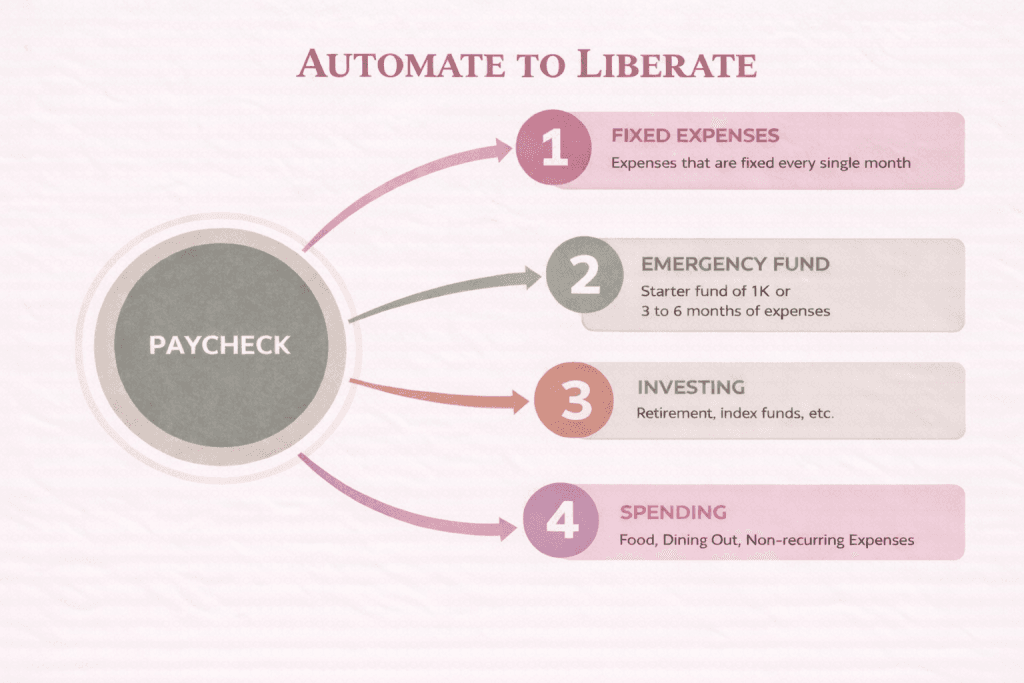
Healthy financial habits become much easier to maintain when they are supported by simple systems rather than daily determination. Simple systems help you change financial habits without having to make the same decision from scratch every day. A system is any routine or process that helps you make better financial decisions consistently. Instead of asking yourself to remember everything or rely on willpower, you create structures that make the next helpful action simple and obvious. Some systems are automatic. Others simply reduce the number of decisions you need to make.
For example, you might:
- automatically transfer money into savings every payday,
- automate regular bill payments,
- schedule automatic investment contributions,
- keep a calendar for annual or irregular expenses,
- plan your meals before grocery shopping,
- prepare a shopping list before leaving home,
- or schedule a weekly money check-in.
Each system removes a little friction from managing your finances. Instead of deciding what to do every week, you already have a routine that supports your financial goals. Over time, these routines reduce stress because you no longer depend on memory, perfect timing, or constant self-control. The goal is not to automate every financial decision. Some decisions deserve careful thought, especially when your priorities or circumstances change. The goal is to simplify the routine parts of managing money so that you have more time and mental energy for the choices that truly matter. When your systems support your spending plan, healthy financial behaviors gradually become part of everyday life instead of something you constantly have to think about.
Change Your Environment, Not Just Your Habits
Many people believe they need more self-discipline to manage money well. In reality, your environment often influences your financial decisions more than your determination does. Every day you are surrounded by opportunities to spend money. Promotional emails arrive in your inbox. Shopping apps send notifications. Social media encourages comparison. Online stores remember your payment details, making purchases fast and effortless.
Instead of trying to resist every temptation, ask yourself:
How can I make the healthier financial choice the easier choice? Changing your surroundings can make it much easier to change financial habits and maintain them over time. That simple question changes your focus. Rather than fighting your habits every day, you begin designing an environment that naturally supports them.
For example, you could:
- unsubscribe from marketing emails,
- remove shopping apps you rarely use,
- delete saved payment details from online stores,
- prepare a shopping list before leaving home,
- avoid browsing online stores when you feel bored or stressed,
- keep a wish list for non-essential purchases,
- plan your meals before grocery shopping,
- or leave your credit card at home when you know you tend to spend impulsively.
None of these changes eliminate temptation completely. They simply reduce the number of situations where you need to rely on self-control. Your environment also includes the people around you. Family members, friends, colleagues, and social expectations can all influence the way you spend money. While you cannot control every situation, you can decide which financial habits you want to protect and which financial boundaries you may need to set. This idea extends far beyond money. One of the most powerful ways to create lasting change is to build a life that supports the person you want to become.
Instead of constantly trying to change yourself, gradually shape your surroundings so that healthier choices become the natural ones. When your environment supports your goals, your habits require less effort, your systems become easier to follow, and your financial decisions become more consistent. That is exactly what the Modify stage of the AVM Method is designed to help you do.

Create a Weekly Money Check-In
Many people only pay attention to their finances when something goes wrong. An unexpected expense appears. A bill is higher than expected. The account balance feels lower than usual. By the time they finally look at their finances, the problem has often been developing for weeks or even months. A weekly money check-in helps you stay connected to your finances before small problems become larger ones. It also gives you a regular opportunity to change financial habits gradually, based on what is actually happening in your life.
Think of it as a regular conversation with your money rather than an inspection or a test. You are not checking whether you have been “good” or “bad.” You are simply staying aware of your financial situation so you can respond before small issues become major sources of stress. Your weekly money check-in only needs about 15 to 20 minutes. Choose a time that fits naturally into your routine. Sunday evening, Friday afternoon, or Monday morning all work well—as long as you are consistent.
During your weekly money check-in, you might:
- review your bank account balances,
- compare your recent spending with your AVM Spending Plan,
- look at upcoming bills and irregular expenses,
- transfer money to savings or investments if needed,
- notice anything unexpected,
- adjust your spending plan for the coming week,
- and choose one realistic financial action to focus on next week.
Notice what naturally happens during this routine. You briefly analyze what happened during the past week. You modify your spending plan, habits, or priorities where needed. Then you continue moving toward the financial future you already visualized. Your weekly money check-in becomes a small AVM cycle. The detailed Analyze – Visualize – Modify process helps you build your financial foundation. Your weekly check-in helps you maintain it as your life changes.
This is exactly why the AVM Spending Plan is designed to be flexible rather than fixed. Life changes. Your income may change. Unexpected expenses appear. Family responsibilities shift. Your goals evolve. Your financial plan should evolve as well. A weekly review allows you to notice those changes early and make small adjustments before they become larger problems. The goal is not to follow your spending plan perfectly. The goal is to keep it realistic. A flexible spending plan that grows with your life will almost always serve you better than a perfect plan that no longer reflects your reality.
What to Do When You Slip Back
No matter how committed you are, there will be weeks when you spend more than you planned. An unexpected expense may appear. You may skip your weekly money check-in. You may make an impulse purchase or postpone saving because life simply became overwhelming. That does not mean your spending plan has failed. It means life happened. Lasting financial change is not about avoiding every setback. It is about knowing how to respond when one happens. Instead of judging yourself, become curious.
Ask yourself:
- What happened this week?
- Was this expense planned or unexpected?
- What situation or emotion influenced my decision?
- Does my spending plan still reflect my current circumstances?
- What is one small adjustment I can make next week?
These questions shift your attention from blame to learning. Sometimes the lesson is about your habits. Sometimes it is about your systems. Sometimes it is about your spending plan itself. Perhaps your grocery budget is no longer realistic. Perhaps you forgot about an annual expense. Perhaps you need to automate another payment or adjust one of your spending categories. A setback often reveals something that needs attention. That does not make it a failure. It makes it valuable.
Every time you review what happened and make one practical improvement, you strengthen your financial system instead of abandoning it. The goal is not to return to perfection. The goal is to return to your next helpful action. That might mean reviewing your spending plan, restarting your weekly money check-in, postponing one unnecessary purchase, or making your next savings transfer. Financial confidence is not built by always getting everything right. It is built by knowing that, even when life gets in the way, you know how to begin again.
Progress Matters More Than Perfection
Many people believe that successful money management means never making mistakes. They imagine that financially responsible people always follow their spending plan perfectly, never overspend, and never make impulse purchases. Real life is rarely that predictable. Unexpected expenses, family responsibilities, career changes, health issues, and changing priorities are all part of life. Financial wellbeing is not built by making perfect decisions every day. It is built by making better decisions more often than before.
If you look back six or twelve months and notice that you feel calmer about money, save more consistently, recover more quickly after setbacks, or understand your finances better than you did before, you are making real progress. That progress deserves recognition. The AVM Spending Plan is designed to grow with you. As your circumstances change, your spending plan should change too. A spending plan that adapts to your life will always be more valuable than one that only works under perfect conditions.
Instead of asking yourself,
“Have I finally mastered money?”
try asking,
“What is one improvement I can make from where I am today?”
That single question keeps you learning, adapting, and moving forward—one practical step at a time.
FAQ: Modify Your Financial Habits
There is no fixed timeline for how long it takes to change financial habits. Some habits begin to feel natural within a few weeks, while others take several months. The important part is not how quickly you change but how consistently you repeat the new behavior.
Choose one habit that feels realistic enough to repeat every week. For many people, this could be setting up an automatic savings transfer, reviewing their AVM Spending Plan once a week, or waiting 24 hours before making an unplanned purchase.
Old habits often return during periods of stress, fatigue, or emotional overwhelm because they are familiar and require little conscious effort. Instead of seeing this as failure, use it as an opportunity to understand what triggered the behavior and decide on one practical adjustment for next time.
Improving your financial habits can help you gain greater clarity, reduce unnecessary spending, prepare for future expenses, and feel more in control of your money.
However, if your income is not enough to cover your essential living expenses, changing habits alone may not solve the problem. In those situations, improving your financial wellbeing may also involve increasing your income, reducing debt, seeking available support, or exploring other practical options alongside healthier financial habits.
If you are rebuilding your finances after divorce, unemployment, illness, or another major life change, remember that progress is not measured only by how much you save. Building stability, creating supportive routines, and making thoughtful financial decisions are meaningful achievements too.
Your spending plan should evolve as your life changes. A new job, divorce, retirement, health issues, or changing family responsibilities may all require adjustments.
Regular money check-ins help you review your situation, make practical changes, and keep your spending plan aligned with your current reality.
Conclusion
Learning to change financial habits is not about becoming a different person overnight. It is about making intentional choices that gradually become part of the way you live. Some weeks will go exactly as planned. Others will bring unexpected expenses, changing priorities, or moments when you fall back into familiar routines. That is part of life. What matters is not whether your journey is perfect. What matters is whether you keep returning to it. The AVM Method is designed to support that process.
Whenever life changes, you can pause, understand your current reality, adjust your spending plan, and continue moving toward the financial future that matters to you. Over time, those repeated adjustments become something much bigger. Those repeated adjustments gradually become confidence, stability, and trust in your ability to manage whatever life brings next. You do not have to change everything today. Choose one habit. Create one supportive system. Take one meaningful step. Then let tomorrow build on today. The future you want is not created by the promises you make. It is created by the choices you repeat.
Ready to Build Financial Habits That Last?
Understanding your financial habits is only the beginning. Putting them into practice is what creates lasting change.
If you’re ready to organize your finances with confidence, download my free AVM Spending Plan Excel Worksheet.
It will help you:
- understand where your money goes,
- organize your spending into meaningful categories,
- prepare for future expenses,
- build a flexible spending plan,
- and turn financial goals into everyday habits.
The worksheet follows the same Analyze → Visualize → Modify process you’ve explored throughout this article, making it easier to turn knowledge into action.

Download your free AVM Spending Plan Excel Worksheet and start building a financial system that grows with you.