
The AVM Spending Plan is designed to help you create a financial life that supports the way you want to live not simply manage numbers. Many traditional budgeting methods focus on cutting expenses, limiting spending, and following fixed financial rules. These tools can be useful, but they often overlook an important part of financial planning: people do not make money decisions based on mathematics alone.
Your financial choices are also shaped by your habits, emotions, beliefs, responsibilities, priorities, relationships, and current life circumstances. You may create a detailed budget with the best intentions and still stop following it after a few weeks. This does not necessarily mean that you lack discipline. It may simply mean that the system does not fit your real life. The AVM Spending Plan takes a broader approach.
It helps you understand both:
- where your money goes,
- and why you use it the way you do.
This awareness allows you to create a spending plan that is realistic, flexible, and connected to your values rather than built around restriction and guilt. Whether you are trying to stop living paycheck to paycheck, rebuild your finances after divorce, prepare for retirement, reduce financial stress, or save for an important goal, the AVM Spending Plan helps you make more intentional decisions with the money you have. It is not a rigid formula. It is a flexible financial framework that can evolve as your income, circumstances, priorities, and goals change.
What Is the AVM Spending Plan?
The AVM Spending Plan is a flexible financial planning framework based on the Analyze–Visualize–Modify Method. It combines practical money management with self-awareness and gradual behaviour change, helping you make intentional financial decisions and build habits you can maintain over time.
The framework guides you through three connected stages:
- Analyze your current financial reality, including your income, expenses, debt, savings, investments, habits, and emotional spending patterns.
- Visualize the financial life you want to create and identify the priorities and goals your money should support.
- Modify your spending plan, routines, and financial habits through small, realistic actions you can maintain over time.
The purpose of the AVM Spending Plan is not simply to help you spend less. Its purpose is to help you use your money more intentionally so that it supports your needs, values, wellbeing, and long-term direction. Instead of forcing your life into a fixed budgeting formula, you create a spending plan around the life you are living now and the life you want to build next.

Key Takeaways
- The AVM Spending Plan combines financial planning with the Analyze–Visualize–Modify Method.
- It helps you understand both your financial numbers and the habits, emotions, and beliefs behind them.
- It replaces rigid budgeting rules with a flexible spending plan adapted to your real circumstances.
- It organises your money into four main categories: Essential Spending, Savings, Investments, and Lifestyle Spending.
- It focuses on small, consistent improvements rather than drastic restrictions or short-term motivation.
- It can be adjusted whenever your income, priorities, responsibilities, or stage of life changes.
- The goal is not to create a perfect budget. The goal is to build a financial system you can realistically use and maintain.
How the AVM Spending Plan Works
Lasting financial change rarely comes from creating one perfect budget. It develops through a continuous process of understanding your current situation, deciding what you want your money to support, and making practical adjustments over time. The AVM Spending Plan follows three connected stages.
Analyze
First, you look honestly at your current financial reality. This includes your income, Essential Spending, Savings, Investments, debt, Lifestyle Spending, and financial habits. You also begin to notice the emotions, beliefs, and patterns that influence your money decisions. The purpose of this stage is not to judge your past choices. It is to replace assumptions with clear information.
Visualize
Next, you decide what kind of financial life you want to create. You identify the goals, priorities, and values your money should support. This gives your spending plan direction and helps you make decisions based on what matters to you rather than on guilt, comparison, or external pressure.
Modify
Finally, you turn awareness and direction into practical action. You adjust your spending plan, create simple systems, and build financial habits you can maintain in everyday life. Rather than trying to change everything at once, you focus on small improvements that gradually become part of your normal routine. These three stages form a continuous cycle. As your income, responsibilities, priorities, and life circumstances change, you return to the AVM Method:
- Analyze what is happening now.
- Visualize what you need next.
- Modify your plan accordingly.
This is what makes the AVM Spending Plan flexible and sustainable over time.

Analyze: Understand Your Current Financial Reality
In the broader AVM Method, the Analyze stage begins by understanding your current life before deciding what needs to change. If you want to apply this process beyond money, start with How to Analyze Your Life Using the AVM Method.
Every meaningful financial change begins with understanding where you are today. Many people avoid looking closely at their finances because it feels uncomfortable. They worry about discovering more debt than expected, realising how much they spend on small purchases, or recognising that their income no longer matches their current responsibilities. These feelings are completely normal. However, avoiding your finances does not solve financial problems. It simply delays the decisions that could improve your situation.
The purpose of the Analyze stage is not to criticise yourself or feel guilty about past choices. It is to replace assumptions with facts. Before you can create a realistic spending plan, you need to understand both your financial situation and the behaviours behind it. The Consumer Financial Protection Bureau also recommends starting with a realistic picture of your income, spending, and bills before creating a budget that works for you.
Ask yourself questions such as:
- Where does my money actually go each month?
- Which expenses are essential, and which are optional?
- Do my spending habits reflect my priorities?
- Which financial decisions reduce my stress?
- Which habits create unnecessary financial pressure?
These questions are not about finding perfect answers. They are about increasing awareness.
Your Money Tells a Story
Every transaction reflects a decision. Over time, those decisions reveal patterns. They show what you value, what you avoid, what brings you comfort, and where your financial stress comes from. Perhaps you spend money to save time because you feel exhausted after work. Perhaps you buy things when you feel lonely, celebrate success with expensive purchases, or postpone opening bills because they make you anxious. These patterns are not personal failures. They are valuable information. The more clearly you understand them, the easier it becomes to make intentional financial decisions instead of automatic ones.
Awareness Comes Before Change
Many people believe that better money management depends on stronger self-discipline. In reality, it often begins with greater awareness. When you understand your income, spending, Savings, Investments, debt, and financial habits, you no longer have to rely on guesswork. You can make decisions based on facts rather than assumptions. You will not make perfect decisions every time, but you will notice problems earlier, adjust your spending plan with greater confidence, and continue improving over time. That is why Analyze is the foundation of the entire AVM Spending Plan.
Ready to analyze your finances? Follow the complete step-by-step guide to understand your income, spending patterns, and current financial reality.

Visualize: Define the Financial Life You Want to Create
Once you understand your current financial reality, the next step is deciding where you want to go. Many people spend years managing their money without ever asking one important question:
What kind of life do I want my money to support?
Without a clear direction, financial decisions often become reactive. You save because you feel you should. You delay spending because you feel guilty. You postpone your dreams because you are waiting for the “right time.” The AVM Spending Plan encourages a different approach.
Instead of asking, “How can I spend less?”, ask:
“How can my money help me build the life I truly want?”
That simple shift changes the purpose of financial planning.
Build Your Spending Plan Around Your Values
Money is a tool, not the destination. Its purpose is to support the life that matters most to you. For one person, financial success may mean becoming debt-free. For another, it may mean reducing financial stress, changing careers, travelling more, spending more time with family, starting a business, or preparing for retirement. None of these goals is more important than another. The important question is whether your financial decisions reflect your own values rather than the expectations of society, social media, or other people.
Look Beyond Financial Numbers
Financial goals often focus on numbers:
- saving a certain amount,
- paying off debt,
- investing regularly,
- building an emergency fund.
These goals are important, but they are only part of the picture. Behind every financial goal is usually a deeper reason. You may want an emergency fund because you value security. You may invest because you want greater independence. You may reduce debt because you want more freedom and less financial stress. Understanding why a goal matters makes it much easier to stay committed when motivation naturally rises and falls.
Think About Your Whole Life
When creating your financial vision, think beyond money itself.
Consider the life you want to build across all five pillars of wellbeing:
- Family, Partner, and Friends
- Career, Work, and Income
- Health, Fitness, and Personal Style
- Hobbies and Activities
- Home Organization
Money supports every one of these areas. The clearer your vision becomes, the easier it is to decide where your money should go. As your life changes, your financial priorities will naturally change as well. A career move, divorce, children leaving home, health challenges, or retirement may all lead you to adjust your goals. That is not a failure. It is exactly why the AVM Spending Plan is designed as a flexible framework rather than a fixed budget.
Continue reading: Ready to turn your priorities into meaningful financial goals? Read Visualize Your Financial Future, where you’ll learn how to create a financial vision that guides your everyday financial decisions.
Modify: Build Financial Habits That Last
Understanding your finances gives you clarity. Knowing what you want gives you direction. But neither will change your financial future unless your daily actions begin to change as well. This is the purpose of the Modify stage. It focuses on turning your spending plan into practical habits that become part of everyday life.
Many people believe that financial success comes from making one dramatic decision: creating a strict budget, starting a no-spending challenge, or promising to change their lifestyle completely overnight. These approaches may work for a short time, but lasting financial change usually happens differently. It grows through small actions repeated consistently.
Small Habits Create Lasting Results
Rather than trying to change everything at once, begin with one or two habits you can realistically maintain.
For example, you might:
- review your spending once a week,
- plan your grocery shopping before going to the store,
- wait 24 hours before making an impulse purchase,
- automate your savings,
- check your bank account regularly instead of avoiding it.
None of these habits is complicated. However, when repeated over weeks and months, they can completely change the way you manage your money. Financial confidence is rarely built through one perfect month. It develops through hundreds of intentional decisions made over time.
Create Systems Instead of Relying on Motivation
Motivation changes from day to day. Simple systems continue working even when your motivation fades. Automatic savings, scheduled bill payments, regular financial reviews, and clear spending routines reduce the number of decisions you need to make each month. They also make it easier to stay consistent when life becomes busy or stressful. The goal is not to control every euro perfectly. The goal is to make good financial decisions easier to repeat.
Progress Is Better Than Perfection
No spending plan works perfectly every month. Unexpected expenses, changing priorities, family responsibilities, and rising living costs are all part of real life.
When something changes, return to the AVM Method:
- Analyze your current situation.
- Visualize your updated priorities.
- Modify your spending plan and habits.
This ongoing cycle is what makes the AVM Spending Plan sustainable. Instead of trying to create one perfect budget, you build a financial system that continues to evolve with your life.
Continue reading: Looking for practical ways to build healthier money habits? Read Modify Your Financial Habits, where you’ll learn simple routines, weekly reviews, automation strategies, and other practical techniques for lasting financial change.
Why Traditional Budgets Don’t Work for Everyone
Many people believe they have failed because they could not stick to a budget. In reality, the problem is often not the person. It is the budgeting system. Traditional budgeting methods usually focus on numbers: how much you should spend, save, or invest. While these guidelines can be helpful, they often overlook something equally important: every person’s financial life is different.
Your money decisions are influenced by your income, family responsibilities, health, career, stage of life, unexpected events, personal values, and long-term goals. A budgeting method that works well for one person may be completely unrealistic for someone else.
Real Life Doesn’t Follow Fixed Percentages
Many popular budgeting systems recommend specific percentages for housing, savings, lifestyle spending, or investments. These can provide a useful starting point, but they should never become rules that make you feel as though you are failing.
A single parent, someone rebuilding after divorce, a family living in an expensive area, or a person dealing with health challenges may need to spend a much larger share of their income on Essential Spending. That does not mean they are making poor financial decisions. It simply means that their financial reality is different.
Financial Planning Should Adapt to Your Life
The goal of the AVM Spending Plan is not to force your finances into someone else’s formula. It is to help you build a spending plan that reflects your circumstances, priorities, and values. As your life changes, your spending plan should change with it. A new job, a growing family, retirement, unexpected expenses, or a major life transition can all create new financial priorities. A flexible spending plan allows you to adjust without feeling that you have failed.
Better Decisions Instead of More Restrictions
Many budgeting systems begin with one question:
“How can I spend less?”
The AVM Spending Plan begins with a different one:
“How can I make better financial decisions?”
Sometimes the answer is reducing unnecessary spending. Sometimes it is building an emergency fund. Sometimes it is paying off debt, investing for the future, or increasing your income. The right solution depends on your individual circumstances. That is why the AVM Spending Plan begins with understanding your financial reality before you choose a budgeting method or financial tool.
The best spending plan is not the one that follows someone else’s rules perfectly. It is the one that helps you manage your own life with greater confidence. Financial planning is not about becoming a different person overnight. It is about understanding yourself well enough to make better decisions, one small step at a time. That is the philosophy behind the entire AVM Method.
The Four AVM Spending Plan Categories
The AVM Spending Plan is a flexible framework rather than a fixed budgeting formula. Instead of forcing every expense into rigid percentages, it helps you organise your money into four practical categories. Together, these categories give you a clear overview of where your income goes and whether your spending reflects your priorities. The goal is not to achieve perfect percentages. The goal is to create a healthy balance between your present needs, future security, long-term goals, and the quality of life you want to enjoy along the way.
Essential Spending
Essential Spending includes the costs that support your everyday life and basic responsibilities.
Examples include:
- housing,
- utilities,
- groceries,
- transportation,
- insurance,
- healthcare,
- childcare,
- basic clothing,
- minimum debt repayments.
Some of these expenses remain fairly stable, while others change from month to month. What they have in common is that they are necessary. That is why the AVM Spending Plan uses the term Essential Spending rather than fixed expenses. Many necessary costs are not fixed, but they are still essential.
Savings
Savings help you prepare for short- and medium-term financial needs while building greater financial security.
This category may include:
- an emergency fund,
- sinking funds,
- annual bills,
- home and car repairs,
- holidays,
- gifts,
- replacing appliances,
- other planned future expenses.
An emergency fund protects you from unexpected events. Sinking funds help you prepare for expenses you know will eventually arise, even if you do not know the exact amount or date. Both belong within the broader Savings category because they reduce financial stress and make it less likely that you will need to rely on debt.
Investments
Investments are intended to support your long-term future.
Depending on your goals, this category may include:
- retirement investments,
- index funds or ETFs,
- education,
- business growth,
- other long-term assets.
Unlike Savings, Investments are generally intended to grow over many years and may increase or decrease in value. Savings help protect your financial stability. Investments help you build long-term financial independence. Both are important, but they serve different purposes.
Lifestyle Spending
Lifestyle Spending includes the money you intentionally choose to spend on the things that make life more enjoyable and meaningful.
This may include:
- hobbies,
- travel,
- dining out,
- entertainment,
- books,
- personal style,
- creative activities,
- experiences with family and friends.
Lifestyle Spending is not careless spending. It is about making conscious choices after considering your essential needs, future security, and long-term goals. A sustainable spending plan should not remove everything that brings joy to your life. It should help you spend intentionally on the things that matter most to you.
Every Category Has a Purpose
These four categories work together.
Essential Spending supports your life today.
Savings prepare you for expected and unexpected expenses.
Investments help you build your long-term future.
Lifestyle Spending allows you to enjoy the life you are creating now.
The balance between these categories will look different for everyone. Someone paying off debt may temporarily spend more on Essential Spending and less on Investments. Someone approaching retirement may choose to increase Investments. Someone rebuilding after a major life change may focus first on strengthening Savings. There is no perfect formula. The right balance is the one that supports your current life while helping you move towards your future goals.
The 50/30/20 Rule as a Flexible Guideline
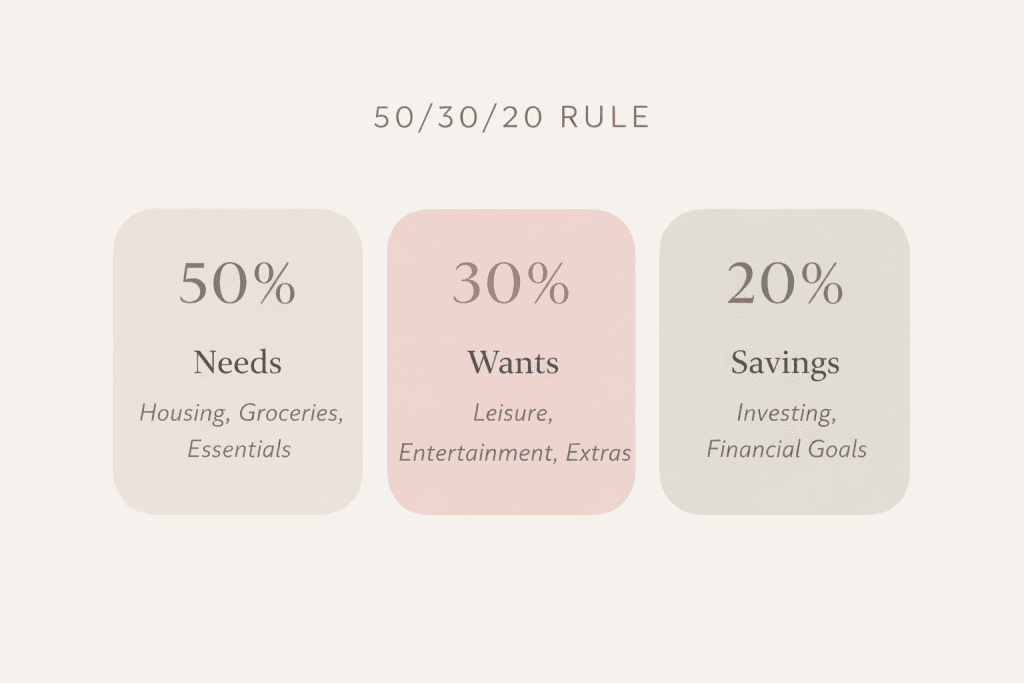
The 50/30/20 rule is one of the best-known budgeting methods.
Traditionally, it suggests dividing your after-tax income into:
- 50% for needs,
- 30% for wants,
- 20% for savings and debt repayment.
It can provide a useful starting point, especially if you want a simple overview of how your income is currently distributed. However, these percentages are not realistic for everyone. A single parent, a woman rebuilding her finances after divorce, someone living on a lower income, or a household facing high housing, healthcare, or childcare costs may need to allocate much more than 50% of their income to Essential Spending. That does not mean they are managing their money poorly. It simply means the suggested percentages do not reflect their current financial reality.
The 20% category is also broader than it may first appear. Depending on your circumstances, it may include:
- emergency savings,
- sinking funds,
- long-term investments,
- retirement contributions,
- additional debt repayments.
In other words, investments can be viewed as long-term savings for your future, while emergency funds and sinking funds help you prepare for shorter-term financial needs. Within the AVM Spending Plan, the 50/30/20 rule is treated as a flexible guideline rather than a strict requirement. You can use it as a point of comparison, adjust the percentages to suit your circumstances, or choose a different approach altogether.
The AVM Spending Plan helps you organise your money into four practical categories:
- Essential Spending
- Savings
- Investments
- Lifestyle Spending
These categories simply give you a clearer picture of how your money is being used. The goal is not to achieve perfect percentages. It is to understand your current financial reality and gradually create a balance that reflects your income, responsibilities, priorities, and future goals.
Continue reading: Learn when the 50/30/20 rule can be helpful, when it may be unrealistic, and how to adapt it in The 50/30/20 Budget Rule.
Emergency Funds and Sinking Funds
An emergency fund and sinking funds both belong in the Savings category, but they serve different purposes. An emergency fund protects you from genuinely unexpected events, such as losing your job, a medical emergency, or an urgent home repair. A sinking fund helps you prepare for expenses you know will happen sooner or later, even if you do not know the exact amount or date. For example, replacing your car tyres, paying your annual insurance premium, buying Christmas gifts, or taking a holiday should not become financial emergencies. They are predictable expenses that can be planned for in advance.
Building both types of savings reduces financial stress and makes it less likely that you will need to rely on debt when these expenses arise. You do not need to build every fund at once. Start with the one that would give you the greatest sense of financial stability, then gradually expand your savings as your circumstances allow.
Continue reading: Learn how to build an emergency fund, create sinking funds, and decide how much to save in Emergency Fund vs. Sinking Funds.
Debt Repayment
Debt can limit your financial flexibility and increase financial stress. Whether you are paying off a credit card, a personal loan, a mortgage, or another type of debt, having a realistic repayment plan can help you regain control while continuing to meet your essential financial responsibilities. The fastest repayment strategy is not always the most sustainable one.
Your repayment plan should take into account:
- interest rates,
- minimum repayments,
- your available income,
- your emergency savings,
- and your ability to stay consistent over time.
For some people, paying off high-interest debt as quickly as possible makes the most sense. Others may need to balance debt repayment with building an emergency fund or covering Essential Spending. The best approach is the one you can realistically maintain. The goal is not to punish yourself for past financial decisions. It is to reduce financial stress, strengthen your financial stability, and gradually create more freedom and flexibility for your future.
Financial Automation
Building good financial habits becomes easier when you reduce the number of decisions you need to make each month. Financial automation helps you put your priorities into action before everyday spending takes over.
You may choose to automate:
- bill payments,
- transfers to Savings,
- Investment contributions,
- debt repayments.
Automation can reduce stress, prevent missed payments, and help you stay consistent during busy or challenging periods. However, automation does not replace financial awareness. Your circumstances, priorities, and goals will continue to change, so it is still important to review your spending plan regularly and adjust it when needed. Within the AVM Spending Plan, automation is a tool that supports your financial habits. It is not a substitute for understanding your finances. When combined with regular reviews, it can make managing money simpler, more consistent, and less stressful.
Increasing Your Income
Reducing unnecessary expenses can improve your finances, but it is not always enough. If most of your income already goes towards Essential Spending, the problem may not be overspending. It may simply be that your income no longer matches your responsibilities or the current cost of living. In that situation, increasing your income may have a greater impact than trying to cut your spending even further.
Depending on your circumstances, you might:
- negotiate a higher salary,
- change jobs,
- develop new skills,
- start a side income,
- build a business,
- create another long-term source of income.
The AVM Spending Plan recognises that lasting financial wellbeing depends on both sides of the equation: managing your money wisely and, where possible, increasing the amount of money available to you. The right approach will depend on your circumstances, responsibilities, and current stage of life.
Continue reading: Explore practical ways to increase your income in Earn More Money on the Side.
No financial tool works on its own. The real value comes from choosing the tools that fit your circumstances and reviewing them as your life changes. That is why the AVM Spending Plan is not a one-time exercise, but an ongoing process.
Review and Adjust Your AVM Spending Plan
Creating a spending plan is not a one-time task. Your income, responsibilities, priorities, and goals will continue to change throughout your life, and your spending plan should change with them. A new job, rising living costs, a growing family, retirement, health challenges, or achieving an important financial goal may all require you to adjust your plan. This is not a sign that your spending plan has failed. It is simply a normal part of managing your money.

Review Before Small Problems Become Bigger Ones
Financial challenges often develop gradually. Subscriptions accumulate. Prices increase. Habits change. Goals evolve. Without regular reviews, it is easy to continue following a spending plan that no longer reflects your current situation. A simple monthly review helps you notice these changes early, allowing you to make small adjustments before they become bigger problems.
Return to the AVM Cycle
Each review is an opportunity to return to the three stages of the AVM Method.
Analyze
- Has my financial situation changed?
- What is working well?
- What needs attention?
Visualize
- Are my goals still the same?
- Have my priorities changed?
- Does my spending still support the life I want to build?
Modify
- Which habits should I continue?
- Which habits should I improve?
- What is one small change I can make this month?
Financial planning is never truly finished. It evolves as your life evolves. That is why the AVM Spending Plan is designed as a living framework rather than a fixed budget.
The AVM Spending Plan Is More Than a Budget
A budget tells you where your money goes. The AVM Spending Plan helps you decide where you want it to take you. It combines practical financial planning with self-awareness, intentional decision-making, and sustainable habit change. Instead of asking you to follow someone else’s rules, it encourages you to build a financial system that reflects your own values, responsibilities, and goals.
Whether you are paying off debt, building an emergency fund, investing for the future, rebuilding after a major life transition, or simply trying to feel more confident with money, financial progress does not come from one perfect decision. It develops through small, consistent choices made over time. Money is not the goal. It is one of the tools that can help you create greater security, freedom, and choice. The purpose of the AVM Spending Plan is not to control every euro. It is to help you make intentional financial decisions that support the life you want to build—one decision, one habit, and one step at a time.
Frequently Asked Questions
A spending plan is a way of managing your money by deciding in advance how you want to use your income.
Unlike a traditional budget, a spending plan focuses on aligning your money with your priorities, values, and long-term goals rather than simply limiting your spending.
A traditional budget usually focuses on controlling expenses and staying within financial limits.
The AVM Spending Plan takes a broader approach by combining financial planning with self-awareness, goal setting, and sustainable habit change.
The goal is not simply to spend less, but to make intentional financial decisions that support the life you want to build.
The AVM Spending Plan is a flexible financial planning framework based on the Analyze–Visualize–Modify Method.
It helps you understand your current financial situation, define meaningful financial goals, and build practical habits that support long-term financial wellbeing.
Yes.
A clear spending plan can become even more important when money is limited.
The AVM Spending Plan helps you prioritise Essential Spending, build Savings where possible, manage debt realistically, and identify opportunities to increase your income over time.
It does not assume that every financial problem can be solved by cutting expenses.
The 50/30/20 rule is one budgeting method that can support your spending plan, but it is not required.
Within the AVM Spending Plan, it is treated as a flexible guideline that can be adapted to your circumstances or replaced by another approach if it does not reflect your financial reality.
Yes.
The AVM Spending Plan does not depend on fixed percentages.
You can use the 50/30/20 rule as a reference, adjust it to suit your circumstances, or create a different balance between Essential Spending, Savings, Investments, and Lifestyle Spending.
The AVM Spending Plan organises your money into four categories:
– Essential Spending
– Savings
– Investments
– Lifestyle Spending
These categories help you understand how your money is being used and create a balance that supports both your present needs and your future goals.
A monthly review is sufficient for most people.
You should also review your spending plan whenever a significant life event changes your income, responsibilities, priorities, or financial goals.
No.
You can manage your spending plan with a notebook, spreadsheet, or budgeting app.
If you prefer a ready-made tool, you can download the free AVM Spending Plan Excel Template to organise your Essential Spending, Savings, Investments, and Lifestyle Spending in one place.
No.
Saving is only one part of the framework.
The AVM Spending Plan also helps you understand your financial habits, organise your spending, prepare for future expenses, invest for long-term goals, manage debt, and use your money intentionally to support the life you want to create.
Neither approach is universally better.
A traditional budget can be useful for tracking income and expenses, while a spending plan focuses more strongly on using your money intentionally to support your goals and values.
The best system is the one that reflects your circumstances and that you can realistically maintain over time.
Download Your Free AVM Spending Plan Excel Template
Reading about financial planning is an important first step. Putting it into practice is what creates lasting change. That’s why I’ve created the free AVM Spending Plan Excel Template—to help you apply the same framework you’ve learned in this guide. Instead of starting with a blank spreadsheet, you’ll have a simple system for organising your Essential Spending, Savings, Investments, and Lifestyle Spending in one place.
Whether you’re trying to stop living paycheck to paycheck, prepare for retirement, rebuild after a major life change, or simply feel more confident managing your money, this template will help you turn ideas into action.
Download your free AVM Spending Plan Excel Template today and start building a spending plan that supports the life you want to create.
This template is designed to accompany the AVM Spending Plan and is completely free. No financial expertise is required—just a willingness to take the first step.
